ACME
An International Journal for Critical Geographies
Revue internationale de géographie critique
Revista internacional de geografía crítica
All articles in this journal are selected through a peer review process.
Volume 25, Number 4, 2026
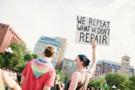
Photo credit: Tim Mossholder, Pittsburgh, PA, Jan. 7 2022
Table of contents (6 articles)
Research
-
Commoning Times; or on the Ethical Potential of Urgency
Elona M. Hoover
pp. 282–299
AbstractEN:
Urgency is a ubiquitous feeling of our contemporary epoch and its incessant crises. Based on ethnographic work with place-based alternative social projects in Paris and London inspired by ideas of the commons, I question the feeling of urgency as something that solely freezes temporal experience through speed or efficiency for instance. I do so by approaching urgency as an atmosphere and explore how it is actually practised. Through three vignettes: making manifestos, crafting campaigns and caring in the meanwhile. These depict urgent atmospheres through relational practices that include multiple temporal relations, involving embodied experiences, socio-ecological histories and future transformations. The examples allow me to untangle three temporal dimensions that reveal urgency’s ethical potential: sensing temporalities, engaging roots and thickening the “now”. This attention to affective practices in relation to collective practices contributes both to making the temporal ethos of commoning more explicit and to (re)claiming urgency’s ethical potential.
FR:
Dans cet article, j’explore le ressenti de l’urgence, omniprésent dans l’expérience contemporaine du déploiement incessant de crises sociales et écologiques. Par un travail ethnographique avec des lieux alternatifs urbains inspirés des notions du commun à Paris et Londres, je déconstruits l’idée que l’urgence est un ressenti temporel unique qui fige, notamment, par la vitesse ou l’efficience. Pour ce faire, j’aborde l’urgence comme atmosphère et j’explore comment elle se traduit dans les pratiques. Au travers de trois vignettes: écrire des manifestes, façonner de campagnes et prendre soin dans l’entretemps. Ces récits décrivent des atmosphères urgentes qui intègrent différentes relations temporelles, et qui incluent les expériences corporelles, les histoires sociales et écologiques, ainsi que la perspective de transformations futures. Les exemples permettent de démêler trois dimensions temporelles qui révèlent le potentiel éthique de l’urgence : ressentir les temporalités, mobiliser les racines et épaissir le ‘maintenant’. Cette attention aux pratiques affectives dans les projets de fabrique de commun peut contribuer à la fois à expliciter l’éthique temporelle du « faire commun » ainsi qu’à (ré)approprier le potentiel éthique de l’urgence.
-
Theorizing Queer Kinship and the Normative Family in the Canadian Sponsorship of Syrian Refugees
Natalie Kouri-Towe
pp. 300–320
AbstractEN:
Canada’s refugee sponsorship initiative gained international attention following the federal government’s 2015 plan to bring 25,000 Syrian refugees to Canada through a combination of government and private sponsorship. The paper draws on media coverage of Syrian refugee sponsorship to examine how discourses around family and kinship in Canada’s sponsorship program risk constraining the pre- and post-resettlement lives of Syrian refugees. Beyond the humanitarian lens, the paper draws on human-interest stories to identify the ruptures and emergences in the language of kinship at play in broader narratives and structures impacting Syrian refugees. Using critiques of heteronormativity emergent in feminist and queer geography, the paper asks how kinship and family are deployed, contested, and shaped in discourses around refugee sponsorship. Juxtaposing the normalization of “family” in tension with non-nuclear forms of kinship, such as extended kin networks and polygamous families, this work draws on queer theories of kinship to question how gender, sexuality, and familial structures are imagined and reconfigured by governments, refugees, and sponsors in the context of resettlement.
-
Life Before the Paper: Resisting the Segregation Between Theory and Action Through Research and Asylum Activism
Camilla Marucco Al-Mimar
pp. 321–339
AbstractEN:
Dismantling oppressive power relations through academic papers and action is key for critical geographers. However, some geographers may prioritise writing “theoretically detached” papers over concretely contributing to the struggles of the people concerned by those papers. They may overlook reflexivity, ethics, and politics, thus spatially and temporally segregating their academic work from action and from their own situated humanity. In violent contexts, separating research from activism and prioritising in time disembodied theoretical papers risks reproducing the status quo in academia and society, reiterating the violence that erases racialised people. As researchers, we have a responsibility to use our power to resist, together with others, dehumanising dynamics. I use autoethnography to analyse some encounters that I have had, as a researcher and activist, with people seeking asylum, activists, researchers, and others in the politicised context of asylum in Finland. Some encounters allowed for the subjectivities and practices of activism and research to co-exist, although with some challenges, while others segregated and marginalised activism. Combining works by critical and feminist geographers, researchers of forced migration, and Black feminist theorists, I examine how where we put our time has ethical, epistemological, and political implications. I invite researchers to re-centre our situated humanity in our work and to engage more with politics. My novel focus on temporalities enriches discussions about crossing the borders between theory and activism. Lastly, I suggest ways to meet people navigating injustice in the times and spaces relevant to them, both within and beyond academia.
-
Ta’ārof as a Baggage and Gift for Crossing White Ontologies
Zeinab Karimi and Kolar Aparna
pp. 340–355
AbstractEN:
In this paper, we analyse our own bodily experiences in everyday interactions in relation as scholars and women of colour in Europe. We aim to build on ta’ārof (تعارف) as an ontological and epistemological standpoint to situate our bodily experiences. We follow encounters and experiences where ta’ārof is both a gift with the potential for unsettling whiteness and a baggage that settles as sediments feeding racial hierarchies in the contact zone of academic encounters. We closely analyse different ways in which ta’ārof was performed in forms of hospitality, gratitude, respect, and self-breaking, and situate it in relation to asymmetries of racial encounters in academia. The inability to understand the knowledges around ta’ārof did not put the white gaze in an inferior position. Instead, the ontological blindness was translated to reproduce the orientalist gaze by positioning us primarily as informants, thereby denying our epistemic authority. The paper invites the reader to reflect on the politics and ethics of academic knowledge production through the standpoint of ta’ārof, especially in the spaces of the classroom, fieldwork, and formal and informal interactions of Knowing.
-
Locating a Sentido de Lugar: Community Writing and Sensorial Storywork as Geographic Method
Kaily Heitz and Elybeth Alcantar
pp. 356–379
AbstractEN:
In this paper, we make a case for community-based writing workshops as a valuable method for understanding senses of place, and how participatory writing can be a powerful tool for developing collaborative community research. We frame this methodology as “sensorial storywork.” Drawing on “sensed” and “sensual” written information, we offer sample geographic analyses based on five experimental writing workshops produced collaboratively with community partners in Oakland, California. We find that writing workshops that center marginalized senses of place enables closer study of the coproduction of race and place, while also functioning as sites of solidarity in the face of inequitable development.
ES:
En este artículo, argumentamos a favor de los talleres de escritura basados en la comunidad como un método valioso para comprender los sentidos del lugar, y que la escritura participativa puede ser una herramienta poderosa para desarrollar la investigación comunitaria colaborativa. A partir de la información escrita "sentida" y "sensual", ofrecemos representaciones de análisis geográfico basadas en cinco talleres de escritura experimental producidos en colaboración con socios comunitarios en Oakland, California. Encontramos que los talleres de escritura que se centran en los sentidos marginados del lugar funcionan como sitios para desaprender las narrativas hegemónicas sobre el lugar, y producen narrativas útiles para comprender los procesos político-económicos que informan las construcciones corporales y psíquicas del lugar.
-
The Machete Must Not Go: Disarming Political Affect after Plantations
Mat Keel
pp. 380–395
AbstractEN:
Trauma is increasingly representationally overworked but conceptually undertheorized. This paper intervenes by arguing that the post-traumatic trigger is best understood as a diagram rather than a representation, not a symbol of trauma but a material component of it. Two ethnographic vignettes ground a speculative examination: in 2023, cane machetes were removed from a New Orleans gallery exhibition, and my third-grade son in Baton Rouge was censured for asking why his school sold chocolate made by enslaved labor during Black History Month. Across both, institutions manage political affect (the capacity to affect and be affected) as if the machete were a symbol whose danger follows from what it means and could therefore be contained by subtraction. I name this operation representational foreclosure: the preemptive withdrawal of an object from relation. The movement performs as protective care, but like the ongoing absence of a National Museum of Slavery, which Sharpe (2016) argues is itself epistemic, this withdrawal does not shield the wounded; it only redacts violence. The operation also does not map to its stated object. The trigger operates diagrammatically, by threatening to re-enact the force-assemblage of which the machete was a material part, not by signifying. The plantation assemblage persists without the machete present; foreclosure manages the symbolic register while leaving untouched the diagrammatic capacity it cannot reach. The vignettes foreground a political technology in which institutions operationalize a representational model of trauma to foreclose on the conditions of their own disassembly.