

 ror.org/0566t4z20
Abstracts
Abstract
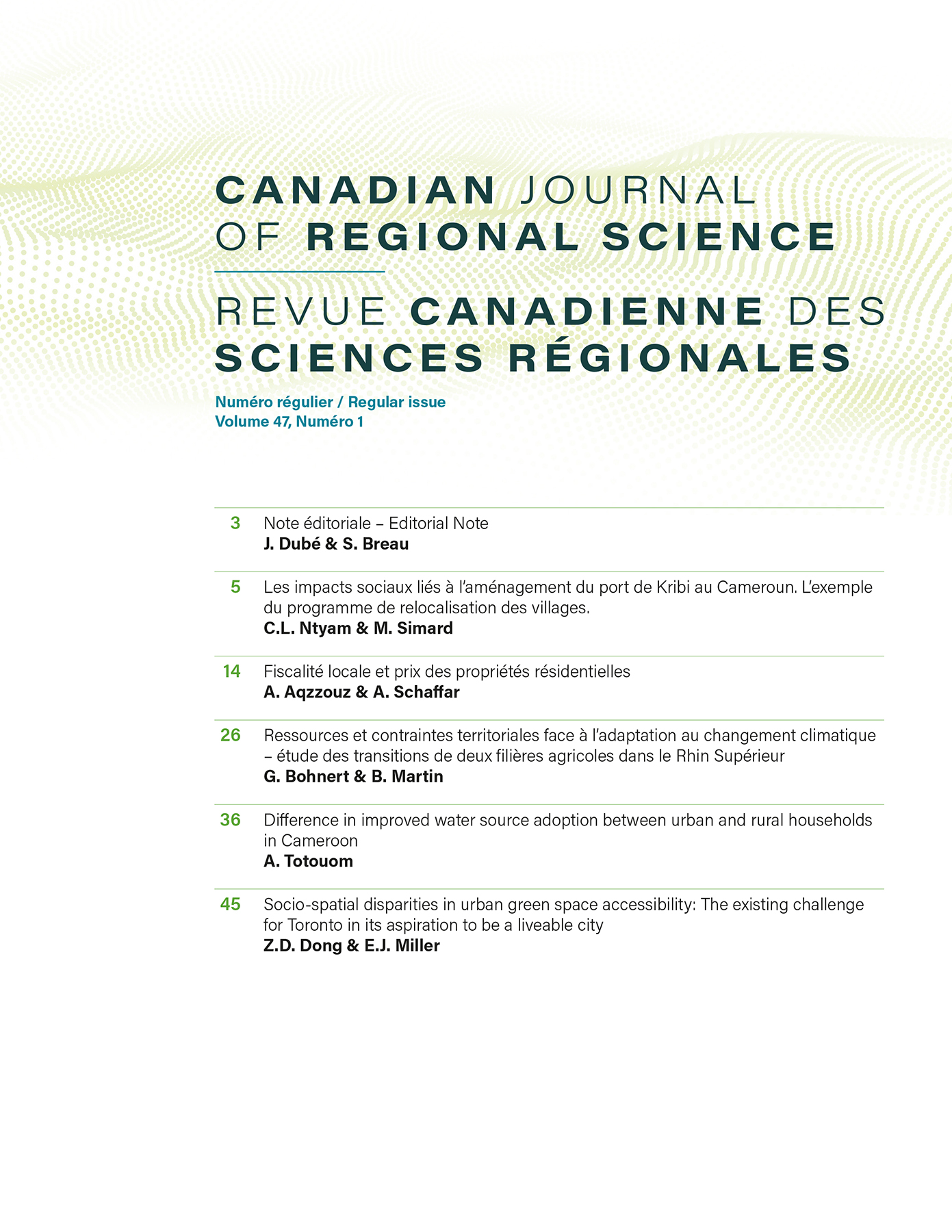
Many households living in developing countries still collect water from unimproved sources. The situation is particularly worse in rural areas. This study analyses the differences in improved water source adoption between urban and rural households in Cameroon. Our analysis uses data from the fifth Cameroon Demographic and Health survey conducted in 2018-2019. Results from logit regressions suggest that the use of improved water source increases when the head of household is a woman. It also increases with education, access to information and wealth. Conversely, it decreases with household size. The approach of Fairlie (2006) is further used to evaluate the contribution of the above factors to urban-rural differences in the adoption of improved water sources. Our analysis shows that the above factors explain 41% of the differences in water source choices observed between urban and rural households. The policy recommendations of the research are described in the paper.
Keywords:
- Adoption of improved water source,
- determinants of adoption,
- urban-rural gap
Download the article in PDF to read it. Download
Appendices
Bibliography
- Abebaw, D., Tadesse, F. & T. Mogues. (2010). Access to Improved Water Source and Satisfaction with Services Evidence from Rural Ethiopia, International Food Policy Research Institute Discussion Paper 01044.Google Scholar Search this bibliographic reference on Google Scholar
- Adams, E. A., Boateng, G. O. & J A. Amoyaw. (2016). Socioeconomic and Demographic Predictors of Potable Water and Sanitation Access in Ghana, Social Indicators Research, 126 (2): 673-687.10.1007/s11205-015-0912-y Google Scholar Search this bibliographic reference on Google Scholar
- Akerlof, G.A. (1970). The Market for “Lemons”: Quality Uncertainty and the Market Mechanism, The Quarterly Journal of Economics, 84(3): 488-50010.2307/1879431 Google Scholar Search this bibliographic reference on Google Scholar
- Atangana Ondoua H. (2021). Inequality in the Distribution of Electricity and Water in Urban Areas: The Case of Cameroon, The Journal of Energy and Development, 45(1-2): 65-91.Google Scholar Search this bibliographic reference on Google Scholar
- Barnwal, P., Van Geen, A., Von Des Goltz, J. & Singh, C.K. (2017). Demand for Environmental Quality Information and Household Response: Evidence from Well-water Arsenic Testing, Journal of Environmental Economics and Management, 86: 160–192.10.1016/j.jeem.2017.08.002 Google Scholar Search this bibliographic reference on Google Scholar
- Basani, M., Isham, J. & Reilly, B. (2008). The Determinants of Water Connection and Water Consumption: Empirical Evidence from a Cambodian Household Survey, WorldDevelopment, 36 (5): 953–68. 10.1016/j.worlddev.2007.04.021 Google Scholar Search this bibliographic reference on Google Scholar
- Blinder, A. (1973). Wage Discrimination: Reduced Form and Structural Estimates, Journal of Human Resources 8 (4): 436–55. 10.2307/144855 Google Scholar Search this bibliographic reference on Google Scholar
- Boone, C., Glick, P. & Sahn, D.E. (2011). Household Water Supply Choice and Time Allocated to Water Collection: Evidence from Madagascar, Journal of Development Studies, 47 (12): 1826-1850. 10.1080/00220388.2011.579394 Google Scholar Search this bibliographic reference on Google Scholar
- Breuil L. (2004). Renouveler le partenariat public-privé pour les services d’eau dans les pays en développement, comment conjuguer les dimensions contractuelles, institutionnelles et participatives de la gouvernance ? Thèse pour obtenir le grade de Docteur de l’Ecole Nationale du Génie Rurale, des Eaux et Forêts, Centre de Paris.Google Scholar Search this bibliographic reference on Google Scholar
- Briand, A. & Loyal, A. (2013). La demande de raccordement des ménages auprès des petits opérateurs privés d’eau potable, le cas des quartiers périphériques de Maputo, Revue Economique, 64 (4): 685-719. 10.3917/reco.644.0685 Google Scholar Search this bibliographic reference on Google Scholar
- Briand, A., Nauges, C., Strand, J. & Travers, M. (2010). The Impact of Tap Connection on Water Consumption Patterns: The Case of Household Water Use in Dakar, Senegal, Environment and Development Economics, 15 (1): 107-126. 10.1017/S1355770X09990076 Google Scholar Search this bibliographic reference on Google Scholar
- Etia, F. C. D., Mvogo, G., & Bidiasse, H. (2022). Les déterminants d’accès à l’eau potable au Cameroun, African Development Review, 34 (1): 154-170.10.1111/1467-8268.12624 Google Scholar Search this bibliographic reference on Google Scholar
- Fairlie, R-A. (2006). An Extension of the Blinder-Oaxaca Decomposition Technique to Logit and Probit Models. IZA Discussion Paper No. 1917. 10.2139/ssrn.497302 Google Scholar Search this bibliographic reference on Google Scholar
- Institut National de la Statistique & ICF. (2020). Enquête Démographique et de Santé du Cameroun 2018.Yaoundé, Cameroun et Rockville, Maryland, USA : INS et ICF.Google Scholar Search this bibliographic reference on Google Scholar
- Jalan, J., Somanathan, E., & Chaudhuri, S., (2009). Awareness and the Demand for Environmental Quality: Survey Evidence on Drinking Water in Urban India, Environment and Development Economics 14 (6): 665–692.10.1017/S1355770X08005020 Google Scholar Search this bibliographic reference on Google Scholar
- Jaglin S. (2001). L’eau potable dans les villes en développement : les modèles marchands face à la pauvreté. Revue du Tiers Monde, T. XLII, N° 166, pp. 275-30310.3406/tiers.2001.1504 Google Scholar Search this bibliographic reference on Google Scholar
- Larson, B., Minten, B. & Razafindralambo, R. (2006). Unravelling the Linkages between the Millennium Development Goals for Poverty, Education, Access to Water and Household Water Use in Developing Countries: Evidence from Madagascar, Journal of Development Studies, 42 (1): 22–40.10.1080/00220380500356258 Google Scholar Search this bibliographic reference on Google Scholar
- McFadden, D. (1974). “Conditional Logit Analysis of Qualitative Choice Behavior”. In P. Zerembka (Eds). Frontiers in Econometrics, New York: Academic Press; 105–142.Google Scholar Search this bibliographic reference on Google Scholar
- Mu, X., Whittington, D. & Briscoe, J. (1990). Modelling Village Water Demand Behavior: A Discrete Choice-Choice Approach, Water Resources Research, 26: 521-529.10.1029/WR026i004p00521 Google Scholar Search this bibliographic reference on Google Scholar
- Nauges, C. & Van Den Berg, C. (2009). Demand for Piped and Non-piped Water Supply Services: Evidence from Southwest Sri Lanka, Environmental and Resource Economics, 42 (4): 535–549.10.1007/s10640-008-9222-z Google Scholar Search this bibliographic reference on Google Scholar
- Nauges, C. & Whittington, D. (2010). Estimation of Water Demand in Developing Countries: An Overview, World Bank Research Observer, 25 (2): 263-294.10.1093/wbro/lkp016 Google Scholar Search this bibliographic reference on Google Scholar
- Oaxaca, R. (1973). Male–female Wage Differentials in Urban Labour Markets, International Economic Review, 14: 693–709. 10.2307/2525981 Google Scholar Search this bibliographic reference on Google Scholar
- Persson, H.T. (2002). Household Choice of Drinking-water Source in the Philippines, Asian Economic Journal, 16 (4): 303- 316.10.1111/1467-8381.t01-1-00154 Google Scholar Search this bibliographic reference on Google Scholar
- Singh S, Ranjan R, & Gonsalves O-N. (2020). Decomposing the Gaps in Access to LPG across Socio-Religious Groups in Rural India. Journal of Social Inclusion Studies 6 (1): 97–112.10.1177/2394481120944780 Google Scholar Search this bibliographic reference on Google Scholar
- Stigler, G.J. (1961). The Economics of Information, Journal of Political Economy, 69 (3): 213-225.10.1086/258464 Google Scholar Search this bibliographic reference on Google Scholar
- Totouom, A. (2020). Determinants of Pipe-borne Water Consumption by Urban Households in Cameroon, Mondes en Développement, 190 (2): 151-170. 10.3917/med.190.0151 Google Scholar Search this bibliographic reference on Google Scholar
- Totouom, A., Fouéka, S. & Ngouhouo, J. (2018). Determinants of the Avoidance Behaviour of Households to Cope with Unsafe Drinking Water: Case Study of Douala and Yaoundé in Cameroon, Review of Agricultural, Food and Environmental Studies, 99(2): 121-148.10.1007/s41130-018-0069-6 Google Scholar Search this bibliographic reference on Google Scholar
- Wooldridge, J.M. (2002). Econometric Analysis of Cross Section and Panel Data. The MIT Press. Cambridge, Massachusetts London, England.Google Scholar Search this bibliographic reference on Google Scholar
- World Health Organization (2023). https://www.who.int/fr/news-room/fact-sheets/detail/drinking-waterGoogle Scholar Search this bibliographic reference on Google Scholar
- World Health Organization (WHO) and the United Nations Children’s Fund (UNICEF) (2017). ‘Progress on drinking water, sanitation and hygiene: 2017 update and SDG baselines’, Licence: CC BY-NC-SA 3.0 IGO.Google Scholar Search this bibliographic reference on Google Scholar
- Zoungrana, T.D. (2021). Les déterminants du choix d’approvisionnement en eau potable des ménages ruraux de la commune de Koudougou au Burkina Faso. Économie rurale. DOI : https://doi.org/10.4000/economierurale.913510.4000/economierurale.9135 Google Scholar Search this bibliographic reference on Google Scholar